
Lactose Intolerance in Babies: What It Is and What It Is Not
Important notice: Breastfeeding is the best form of nutrition for infants. Infant formula should be used only when a doctor or qualified healthcare professional advises that it is necessary.
A baby who cries after feeds, pulls their legs up, passes wind and seems generally uncomfortable — and somewhere in the second week of this, someone suggests lactose intolerance.
It is one of the most common suggestions parents receive, and one of the least often correct.
This article explains what lactose intolerance in infants actually is, why it is far rarer than most people assume, and — the part that matters most — how it differs from the condition it is most often confused with.
What lactose intolerance actually is
Lactose is the natural sugar in milk. All milk contains it, including breast milk, which contains more lactose than cow’s milk does.
To digest lactose, the body produces an enzyme called lactase. Lactose intolerance means the body is not producing enough lactase, so lactose passes into the large intestine undigested, where it ferments and causes wind, bloating and loose stools.
That is the whole mechanism. It is a digestive enzyme issue, not an allergy, and the distinction matters more than it sounds.
Why it is rare in babies
Here is the part that surprises most parents: babies are born with high lactase levels.
This makes evolutionary sense. A newborn’s entire diet is milk, and breast milk is high in lactose. A baby who could not digest lactose would be in serious difficulty from birth.
Congenital lactase deficiency — being born unable to produce lactase at all — exists, but it is extremely rare. It presents within days of birth with severe, watery diarrhoea and failure to gain weight. It is not subtle, and it is not something a baby has for weeks without anyone noticing.
Lactase production naturally declines in later childhood, which is why lactose intolerance becomes common in older children and adults. In infancy it is genuinely uncommon.
Secondary lactose intolerance — the version that does happen
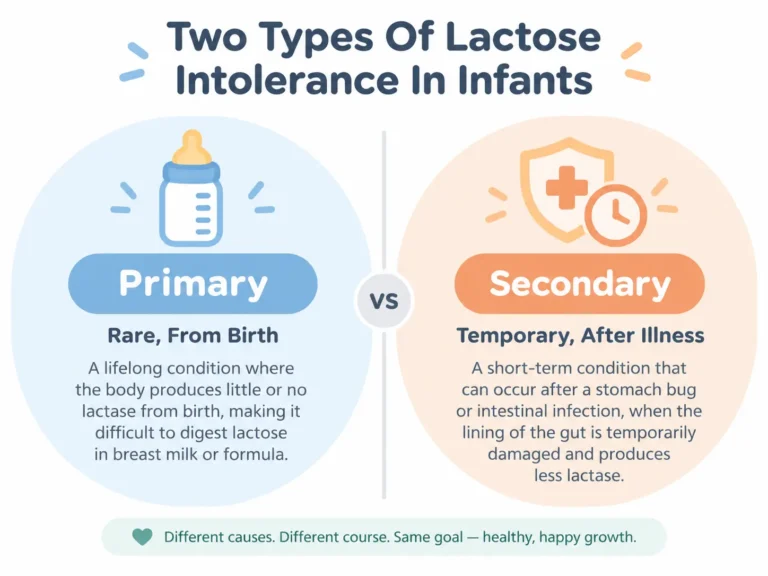
There is a form that is more common, and temporary.
After a bout of gastroenteritis, the lining of the gut can be damaged, and the lactase-producing cells sit right on that lining. For a period after the illness, a baby may genuinely struggle to digest lactose.
This usually resolves on its own as the gut lining recovers, typically within a few weeks. This is the situation in which a doctor most often advises a lactose-free formula — as a short-term measure during recovery, not as a permanent change.
The confusion that matters most
This is the section worth reading twice.
Lactose intolerance and cow’s milk protein allergy are not the same thing, and lactose-free formula does not treat the second one.
Cow’s milk protein allergy (CMPA) is an immune reaction to the protein in cow’s milk. Lactose intolerance is a difficulty digesting the sugar. They are different problems in different systems of the body.
A standard lactose-free formula is still made from cow’s milk. The lactose has been removed or broken down; the protein is still there. So for a baby with CMPA, switching to lactose-free formula changes nothing about the thing causing the reaction.
CMPA is considerably more common in infants than true lactose intolerance, and the symptoms overlap enough that parents — and sometimes well-meaning relatives — reach for the wrong solution.
Babies with diagnosed CMPA need a different type of formula entirely, prescribed and supervised by a doctor.
This is the single strongest reason not to self-diagnose and switch. A change that feels harmless can delay identifying what is actually happening.
Symptoms that are usually not lactose intolerance
Most of what worries parents in the early months turns out to be normal infant behaviour or something else entirely:
Crying in the evening. Common, peaks around six weeks, and usually settles by three to four months.
Wind and pulling legs up. Almost universal in young babies. The digestive system is still maturing.
Frequent or loose stools. Breastfed and formula-fed babies both pass frequent loose stools. What matters is the change from your baby’s normal, not the appearance in isolation.
Posseting or bringing up small amounts. Very common and usually not a problem unless your baby is uncomfortable or not gaining weight.
Being unsettled after feeds. Has many possible causes — feeding position, feed volume, pace of feeding, reflux, or simply a baby who takes time to settle.
None of these on their own points to lactose intolerance.
What would make a doctor consider it
A doctor would look at the whole picture, not a single symptom. The things that carry weight:
- Explosive, watery, frothy stools
- Significant nappy rash from acidic stools
- Poor weight gain or weight loss
- Symptoms that began after a gastrointestinal illness
- Symptoms that are persistent rather than intermittent
Diagnosis is clinical — based on history, examination and how the baby responds — rather than a single test.
Please do not switch on your own

Changing formula without medical advice carries real risks.
It can mask the actual problem. If the cause is CMPA, reflux, a feeding issue or an infection, a formula change delays finding it.
It can unsettle a baby further. Any change of formula takes adjustment, and a baby already uncomfortable does not need another variable.
It rarely resolves anything by itself. Most babies improve over the same period whether the formula changed or not, which makes it easy to credit a change that did nothing.
If you think something is wrong, see your paediatrician. That visit will do more in ten minutes than three weeks of switching box pack.
When to seek help promptly
Contact a doctor without delay if your baby:
- Is not gaining weight or is losing weight
- Has blood or mucus in their stools
- Is vomiting forcefully or repeatedly
- Has signs of dehydration — fewer wet nappies, dry mouth, unusual sleepiness
- Has a rash, swelling around the mouth, or difficulty breathing after feeds
The last one needs urgent medical attention.
In short
True lactose intolerance in infants is uncommon. Babies are built to digest lactose, and most of what gets attributed to it is either normal infant behaviour or something different.
The version that does occur is usually temporary, following a stomach illness, and a doctor may advise a lactose-free formula for a short period during recovery.
Most importantly: lactose intolerance is not the same as cow’s milk protein allergy, and lactose-free formula does not address the second one.
If your baby is uncomfortable, the right next step is your paediatrician — not a different tin.
This article is general information and is not medical advice. Always consult a qualified doctor or paediatrician about your baby’s feeding, digestion or symptoms.
Breastfeeding is best for your baby. Infant formula should be used only on the advice of a healthcare professional.