
What Are DHA, ARA and Nucleotides in Infant Formula?
Important notice: Breastfeeding is the best form of nutrition for infants. Infant formula should be used only when a doctor or qualified healthcare professional advises that it is necessary.

Stand in the baby aisle for five minutes and you will see the same three terms on nearly every tin: DHA, ARA, nucleotides. They are printed large, usually in a coloured box, and almost never explained.
Most parents end up assuming they matter without knowing why. This article explains what each one actually is, why manufacturers include them, and — the part that usually gets left out — what the research does and does not show.
DHA
DHA stands for docosahexaenoic acid. It is a long-chain omega-3 fatty acid.
It occurs naturally in breast milk, and it is a structural component of brain tissue and the retina. That is the simple, uncontested part: DHA is physically present in the brain and eye, and infants accumulate it rapidly in the first months of life.
Where it comes from in formula is usually algal oil or fish oil, depending on the manufacturer.
What the evidence shows: the picture is more mixed than the packaging suggests. DHA is genuinely important in infant development. But whether adding it to formula produces measurably better cognitive or visual outcomes in healthy full-term babies is something researchers have argued about for two decades. Several large reviews have found no clear long-term difference.
For preterm infants the evidence is stronger, which is one reason preterm formulas are formulated differently.
This is worth knowing so you can read a tin with realistic expectations. DHA belongs in formula because it belongs in breast milk. That is a sound reason. It is not a promise about your child’s future.
ARA
Lorem ipsum dolor sit amet, consectetur adipiscing elit. Ut elit tellus, luctus nec ullamcorper mattis, pulvinar dapibus leo.
ARA is arachidonic acid, a long-chain omega-6 fatty acid. It is also present in breast milk, usually at higher concentrations than DHA.
ARA and DHA are almost always added together, and there is a practical reason for that. The two fatty acids compete for the same metabolic pathways in the body. Adding DHA alone can reduce ARA levels, so formula manufacturers include both to keep the balance closer to what is found in breast milk.
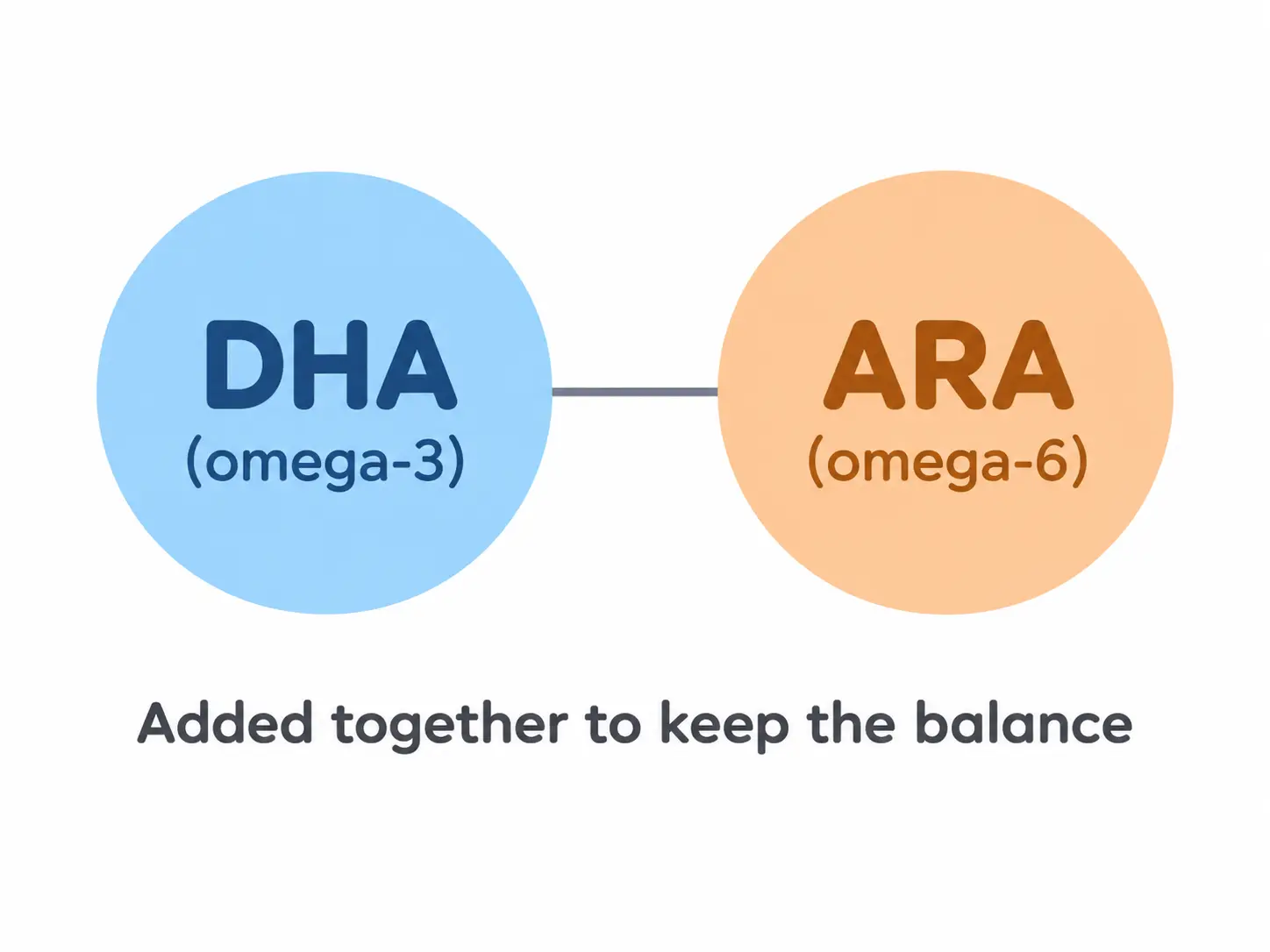
That balance is the point. If you see one without the other on a label, it is reasonable to ask why.
Nucleotides
Nucleotides are the building blocks of DNA and RNA. Every cell in the body contains them, and the body can make its own.
They are present in breast milk, and this is where the interest comes from. Human milk contains more nucleotides than cow’s milk does, so formula manufacturers add them to close that gap.
What the evidence shows: research has looked at whether added nucleotides affect gut development and immune response in infants. Some studies have found effects; others have not. The overall evidence is limited and not conclusive.
Nucleotides are included because they are in breast milk and because there is a plausible reason to think they matter. That is an honest description of where the science currently sits.
Why formula follows breast milk
You may have noticed a pattern in all three explanations.
DHA, ARA and nucleotides are in formula for the same reason: they are found in breast milk. The entire logic of infant formula composition is to get as close as possible to human milk, because human milk is the reference standard.
This is also why no formula claims to be equivalent to breast milk, and why manufacturers are not permitted to suggest it. Breast milk contains hundreds of components — antibodies, live cells, hormones, enzymes — that cannot be replicated in a powder.
Formula exists for situations where breastfeeding is not possible or where a doctor has advised it. Within that role, matching what can be matched is exactly what a formula should do.
How to read a box properly
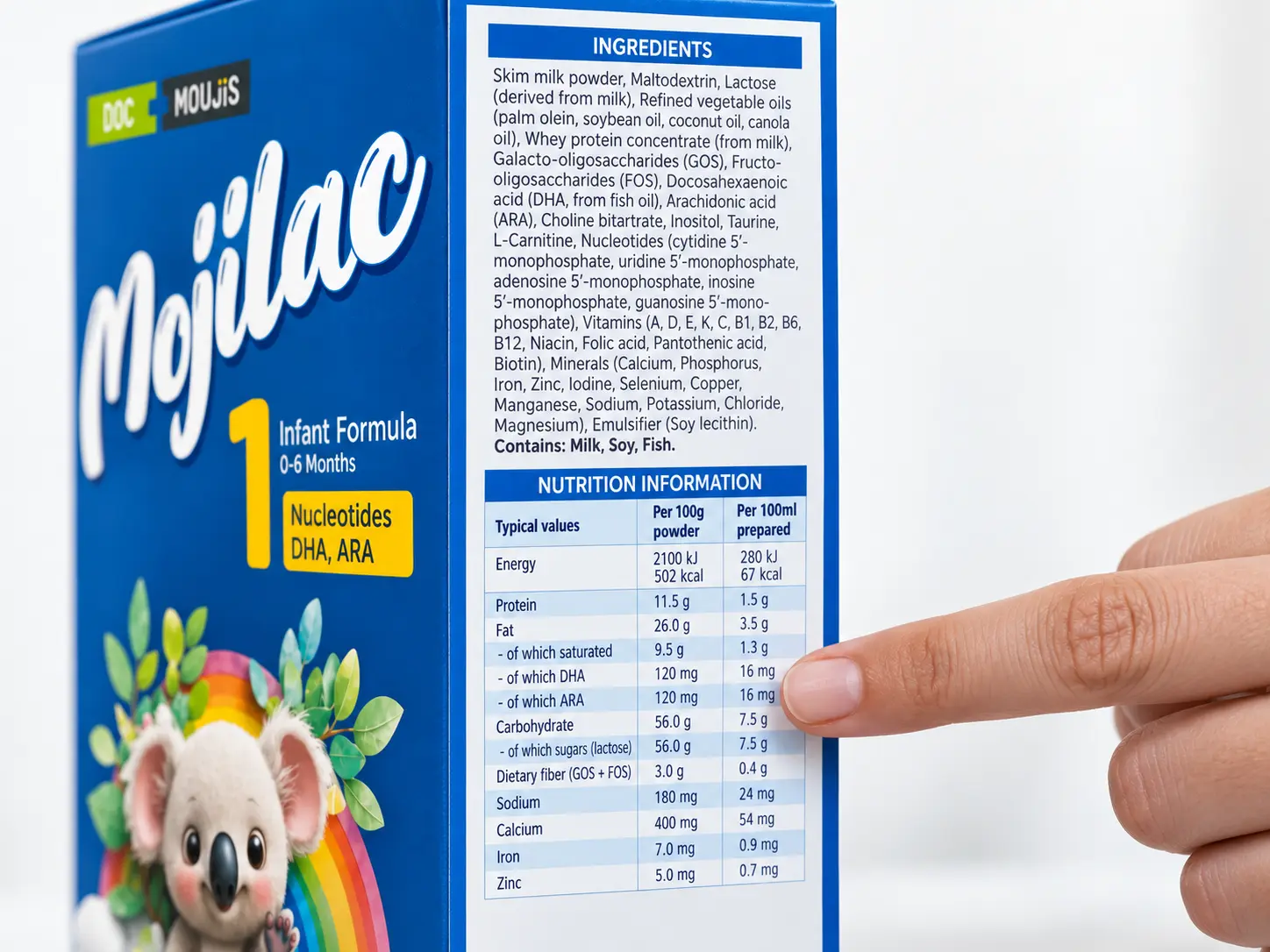
The front of the pack is marketing. The back is information. Three things are worth checking:
The age range. This matters more than anything else on the pack. Stage 1 formula is for 0 to 6 months; stage 2 is for 6 to 12 months. They are formulated differently, and using the wrong one is a real mistake rather than a small one.
The full ingredient list. Not the highlighted box on the front, the actual list on the back.
The preparation instructions. Quantities and water temperature differ between products. If you change brands or stages, read the instructions again — do not assume they are the same.
What these ingredients cannot tell you
No combination of ingredients on a label will tell you whether a formula is right for your baby.
That depends on your baby’s age, weight, how they are feeding and digesting, and whether there is any medical reason to avoid particular ingredients — lactose, for instance. A box pack cannot know any of that.
Speak to your paediatrician before choosing a formula, and before changing one. If your baby is unsettled, not gaining weight, or refusing feeds, that needs a proper assessment rather than a different box pack.
In short
DHA and ARA are fatty acids found in breast milk, added to formula together to maintain balance. Nucleotides are cellular building blocks, also present in breast milk in higher amounts than in cow’s milk.
All three are in formula because they are in breast milk. That is a good reason to include them. It is not the same as a guarantee of any particular outcome, and a label that suggests otherwise is overstating what is known.
Read the age range, read the back of the pack, and ask your doctor. Those three habits will serve you better than any claim printed on the front.
This article is general information and is not medical advice. Always consult a qualified doctor or paediatrician about your baby’s feeding and nutrition.
Breastfeeding is best for your baby. Infant formula should be used only on the advice of a healthcare professional.